Our Unit Converter
The ESI Unit converter allows you to quickly and easily access a conversion tool to work out your preferred unit of pressure measurement wherever you may be. Whether out on-site or in the office.

Download the ESI-USB© Software
The ESI-USB© software allows you to connect your ESI transducer to your laptop or PC and be up and running monitoring pressure data within ten minutes. The software auto-updates and is compatible with Windows 8, 10 & 11.
Safe, Flexible Data Acquisition in Hazardous Areas with the ESI-USB-PLUS
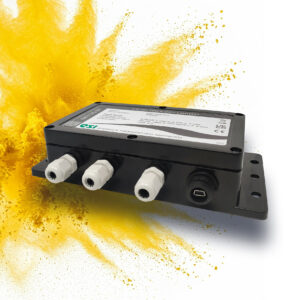 In industries such as oil & gas, hydrogen processing, chemical manufacturing, and pharmaceuticals, accurate pressure measurement is a fundamental part of many processes, but safety is absolutely paramount everywhere. Hazardous areas, where explosive gases or dust may be present, demand instrumentation solutions that not only deliver precision but also comply with stringent intrinsic safety requirements.
Until recently, accessing digital pressure data in these environments using ESI-USB software was not possible. Traditional setups relied on standalone instrumentation or more complex data acquisition systems, limiting flexibility and ease of use. The introduction of the ESI-USB-PLUS has changed that landscape entirely, opening up a new and highly accessible route to digital pressure measurement—particularly in hazardous applications.
When combined with an intrinsically safe pressure transmitter and a suitable Zener barrier, the ESI-USB-PLUS provides a powerful and practical solution for safely capturing and analysing pressure data.
At its core, the ESI-USB-PLUS is a versatile analogue-to-digital interface designed to connect traditional analogue sensors directly to a computer via USB. Supporting both 4–20 mA and 0–10 V input signals, it enables a wide range of pressure transmitters and other process instruments to be monitored, logged, and analysed without the need for complex data acquisition hardware.
The unit also includes an additional input channel for a PT100 temperature sensor, allowing simultaneous pressure and temperature monitoring within a single compact device. With plug-and-play USB connectivity and automatic device detection, users can be up and running within minutes, transforming a laptop or PC into a fully functional measurement station.
Enabling Hazardous Area Measurement
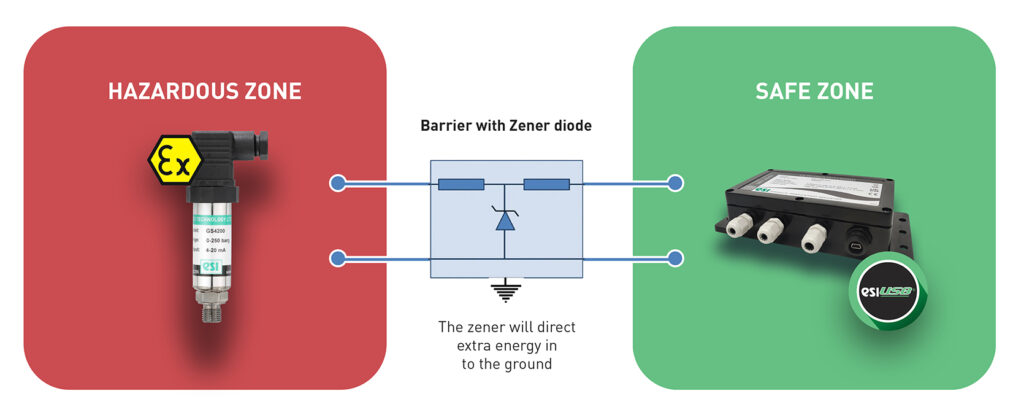
Installing an ESI-USB-PLUS box in order to gather digital data in a hazardous application.
While the ESI-USB-PLUS itself is installed in the safe area, it can be seamlessly integrated into hazardous area applications through the use of an intrinsically safe pressure transmitter installed in the hazardous zone and connected via a Zener barrier.
A Zener barrier acts as a protective interface, limiting voltage and current entering the hazardous area to prevent ignition. This ensures that even under fault conditions, the energy available in the circuit remains below the level required to ignite explosive atmospheres. This method of protection—intrinsic safety—is widely adopted for low-power instrumentation because it prevents ignition rather than containing it.
A practical example of this setup is the use of the GS4200EX intrinsically safe pressure transmitter. Designed specifically for hazardous environments, the GS4200EX provides reliable and accurate pressure measurement while meeting intrinsic safety requirements. Installed within the hazardous area, it delivers a stable 4–20 mA output signal that is ideal for transmission through a Zener barrier.
In this configuration, the GS4200EX measures process pressure in the hazardous zone and transmits its analogue signal safely through the barrier into the safe area, where it is connected to the ESI-USB-PLUS. The interface box then converts this signal into digital data for transmission to a PC.
This architecture allows engineers and technicians to safely access high-quality measurement data without placing computers or non-certified electronics inside hazardous zones. It also eliminates the need for bulky explosion-proof enclosures, simplifying installation and reducing system costs.
Powerful Data Acquisition with ESI-USB Software
The ESI-USB-PLUS is paired with the intuitive ESI-USB software, a fully configurable Windows-based platform that transforms raw measurement signals into meaningful insights. Crucially, it is the ESI-USB-PLUS that enables this software to be used with analogue output transmitters—unlocking digital measurement capabilities that were previously out of reach in many hazardous applications.
Once connected, the software automatically recognises the device and begins streaming live data, enabling real-time monitoring and analysis.
Users can visualise data in both graphical and tabular formats, select preferred engineering units, and adjust scales to suit their application. High-resolution sampling ensures that even dynamic pressure events are captured with excellent fidelity.
Beyond simple monitoring, the software offers advanced functionality including data logging, export to Excel or PDF, and the creation of customised reports and calibration certificates. Features such as alarm settings, automated test sequences, and multi-channel viewing (for up to 16 sensors) make it a powerful tool for laboratory testing, field diagnostics, and process validation.
A Practical Solution for Modern Industry
The combination of the GS4200EX intrinsically safe pressure transmitter, a Zener barrier, and the ESI-USB-PLUS creates a streamlined bridge between hazardous environments and modern digital analysis tools. What was once a gap between analogue field measurement and digital insight has now been cleanly connected.
Compact, easy to deploy, and highly adaptable, the ESI-USB-PLUS transforms complex measurement challenges into a straightforward, plug-and-play experience—bringing clarity, control, and a new dimension of accessibility to pressure measurement in even the most demanding hazardous applications.