Our Unit Converter
The ESI Unit converter allows you to quickly and easily access a conversion tool to work out your preferred unit of pressure measurement wherever you may be. Whether out on-site or in the office.

Download the ESI-USB© Software
The ESI-USB© software allows you to connect your ESI transducer to your laptop or PC and be up and running monitoring pressure data within ten minutes. The software auto-updates and is compatible with Windows 8, 10 & 11.
 Submersible, Depth and Level Pressure Measurement: What You Need to Know
 Submersible, Depth and Level Pressure Measurement: What You Need to Know
Measuring pressure below the surface brings a different set of challenges. Submersible, depth and level pressure transmitters must operate in environments where water, fluid, temperature and installation conditions can all affect performance.
Unlike a standard pressure transmitter, these applications often require the transmitter to spend long periods fully immersed. The sensor must cope with the surrounding environment while continuing to provide stable and accurate pressure measurements.
So, what should you consider when choosing a pressure transmitter for submersible, depth or level measurement?
What are submersible, depth and level pressure transmitters?
Submersible pressure transmitters are designed to operate while immersed in a liquid. They are commonly used for measuring water levels, tank levels, groundwater, boreholes, wells and other applications where the pressure sensor sits below the liquid surface.
Depth measurement works on a similar principle. As the depth of a liquid increases, so does the hydrostatic pressure acting on the sensor.
This relationship allows pressure to be used to calculate liquid depth or level.
However, the application is not simply about putting a pressure transmitter underwater.
The transmitter needs to withstand the surrounding environment. It also needs the correct pressure reference, suitable materials and an installation method that will provide reliable measurements over time.
How does pressure measure liquid level?
The pressure at the bottom of a liquid increases with the height of the liquid above it.
The basic relationship is:
Pressure = density × gravity × height
This means that measuring hydrostatic pressure can provide an indication of liquid level or depth.
For example, a transmitter positioned at the bottom of a water tank will measure greater pressure as the tank fills. The pressure decreases as the level falls.
The density of the liquid also matters. Water, oil and other liquids will produce different pressures at the same depth.
For this reason, the liquid being measured should always be considered when selecting and configuring a pressure transmitter.
Choosing the right pressure reference
One of the most important decisions is the pressure reference.
Submersible and level applications commonly use vented gauge, sealed gauge or absolute pressure measurement. Each option works differently.
Vented gauge pressure
A vented gauge transmitter measures pressure relative to atmospheric pressure.
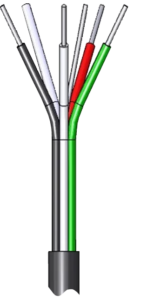 A vented cable allows the transmitter to compensate for changes in atmospheric pressure. This makes vented gauge pressure a common choice for open tanks, wells and water level measurement.
However, the vent needs to remain protected from moisture and contamination. A blocked or flooded vent can affect the measurement.
Sealed gauge pressure
A sealed gauge transmitter uses a fixed reference pressure inside the sensor rather than venting to the atmosphere.
This can be useful where a vented cable is undesirable or where the application requires a sealed construction.
However, changes in atmospheric pressure are not compensated for in the same way as with a vented gauge transmitter. The effect of this should be considered when specifying the transmitter.
Absolute pressure
An absolute pressure transmitter measures pressure relative to a vacuum reference.
It can be useful when atmospheric pressure needs to be included in the measurement or when the application requires an absolute pressure reference.
For liquid level measurement, however, atmospheric pressure and the measurement method need to be considered carefully. Absolute pressure does not automatically provide a direct measurement of hydrostatic pressure alone.
What makes submersible applications different?
Submersible applications introduce several factors that are less important in many conventional pressure measurement installations.
Water and moisture protection
The transmitter may remain submerged for months or even years. Water ingress can therefore have serious consequences.
The pressure connection, electrical connections, cable and sensor housing all need to be suitable for the environment.
A robust construction is particularly important for permanent installations.
Cable design
The cable is more than just an electrical connection.
In a vented level transmitter, it also provides the atmospheric reference to the sensor. The cable therefore needs to protect the vent while allowing atmospheric pressure to reach the sensing element.
Cable length, installation and termination should also be considered. A poorly protected cable can become a weak point in an otherwise robust measurement system.
Corrosion and material compatibility
The liquid being measured can have a major effect on material selection.
Fresh water, seawater, wastewater and industrial fluids can all present different challenges.
The wetted materials should therefore be compatible with the application. In some environments, specialist materials may be required to improve long-term reliability.
Temperature
Temperature can affect pressure measurement in several ways.
Changes in temperature can influence the sensor, electronics and surrounding liquid. Liquid density can also change with temperature, which can affect the relationship between pressure and level.
The expected operating temperature should therefore be included when specifying the transmitter.
What about pressure spikes?
Level measurement may appear relatively gentle compared with hydraulic or process applications. However, pressure spikes can still occur.
Rapid changes in liquid level, pumps, valves and movement within a tank can all create transient pressures.
The transmitter should therefore be selected with the expected pressure conditions in mind.
It is important to consider both the normal operating pressure and any possible overpressure or transient conditions.
Installation matters too
Even a well-specified transmitter can give poor results if it is installed incorrectly.
The position of the transmitter can affect the measurement. It should be located where it can accurately sense the pressure produced by the liquid column.
The transmitter should also be protected from mechanical damage, sediment and excessive turbulence where necessary.
For suspended transmitters, the cable and mounting arrangement should be suitable for the installation. The weight of the transmitter and cable may also need to be considered in deeper installations.
Where are submersible and level transmitters used?
Submersible and depth pressure transmitters are used across many industries and applications.
Typical examples include:
- Water and wastewater treatment
- Groundwater monitoring
- Borehole and well measurement
- Reservoir and dam monitoring
- Tank level measurement
- Irrigation systems
- Flood monitoring
- Marine and offshore applications
- Industrial process tanks
- Environmental monitoring
Each application brings its own combination of pressure, temperature, fluid and installation requirements.
That is why selecting a transmitter based on pressure range alone is rarely enough.
Selecting a pressure transmitter for the application
Before specifying a submersible, depth or level pressure transmitter, it is worth considering the complete operating environment.
Key questions include:
What liquid is being measured?
The fluid affects density, material compatibility and potentially the choice of sensing materials.
How deep will the transmitter be installed?
The maximum depth determines the hydrostatic pressure range required.
What pressure reference is needed?
Vented gauge, sealed gauge and absolute pressure each provide a different measurement reference.
What temperatures will the transmitter experience?
Consider both the normal operating temperature and any temperature extremes.
Will the transmitter remain submerged permanently?
Continuous immersion places different demands on the construction than occasional or temporary use.
Are there corrosive or contaminated fluids?
Material selection becomes particularly important in these environments.
Could the application experience pressure spikes?
The transmitter should be able to cope with the expected operating and transient pressures.
Pressure measurement beneath the surface
Submersible, depth and level applications may share the same basic principle, but the engineering considerations can be quite different from those of a standard pressure measurement application.
The right pressure reference, materials, cable construction, pressure range and environmental protection all play a part.
At ESI Technology, we design and manufacture pressure transmitters for a wide range of specialist applications. Our team can help identify the right pressure measurement solution based on the operating environment, installation and performance requirements.
Need help selecting a pressure transmitter for submersible, depth or level measurement? Get in touch with our team to discuss your application [email protected] +44(0)1978 262255 Or find your local distributor here