Our Unit Converter
The ESI Unit converter allows you to quickly and easily access a conversion tool to work out your preferred unit of pressure measurement wherever you may be. Whether out on-site or in the office.

Download the ESI-USB© Software
The ESI-USB© software allows you to connect your ESI transducer to your laptop or PC and be up and running monitoring pressure data within ten minutes. The software auto-updates and is compatible with Windows 8, 10 & 11.
 How Temperature Affects Pressure Measurement
 How Temperature Affects Pressure Measurement
Temperature can affect pressure measurement in several ways. As temperature changes, the materials and electronics inside a pressure sensor can also change.
This can affect accuracy, stability and long-term performance.
For engineers working with pressure transmitters, it is important to understand how temperature can affect a pressure measurement.
This becomes even more important in applications with extreme temperatures. These include aerospace testing, downhole measurement and high-temperature industrial processes.
Why does temperature affect pressure sensors?
A pressure sensor converts pressure into an electrical signal. Temperature can affect the materials and components used to create this signal.
When temperature rises or falls, materials can expand and contract. The sensing element, diaphragm and other components may respond differently to these changes.
Electronic components can also react to temperature changes.
As a result, the pressure signal can change slightly, even when the actual pressure stays the same.
This is known as thermal error or temperature-induced error.
For applications that need accurate pressure measurement, controlling these effects is important.
What is thermal error?
Thermal error is a change in a pressure sensor’s output caused by temperature.
For example, imagine a pressure transmitter measuring a constant pressure. The temperature around the transmitter then increases.
The actual pressure has not changed. However, the transmitter’s output may move slightly because of the temperature change.
This can result in a pressure reading that is less accurate than expected.
Temperature can affect several areas of pressure transmitter performance, including:
- Zero stability
- Span accuracy
- Repeatability
- Long-term stability
- Response to changing conditions
The level of thermal error depends on the sensor technology, materials, design and operating temperature range.
How does temperature compensation work?
Pressure transmitters can use temperature compensation to reduce the effects of temperature changes.
The transmitter measures how the sensor responds to temperature. It can then use this information to correct the pressure output.
This helps the transmitter maintain greater accuracy across its operating temperature range.
However, temperature compensation is only part of the solution.
The sensor itself must also suit the temperatures it will experience.
Why does sensor technology matter?
Different pressure sensor technologies respond differently to temperature.
At ESI Technology, many of our pressure sensors and transmitters use Silicon-on-Sapphire (SOS) technology.
SOS uses a silicon sensing element bonded to a sapphire substrate. This creates a stable sensing structure with excellent resistance to temperature and pressure effects.
The technology provides high accuracy and stability across a wide range of operating conditions.
This can be particularly useful when a pressure transmitter must work in an environment with large temperature changes.
When does temperature become a problem?
Not every pressure application involves extreme temperatures.
However, engineers should consider temperature when selecting any pressure transmitter.
There are several temperatures to consider:
- Pressure media temperature
- Ambient temperature
- Sensor temperature
- Electronics temperature
These temperatures may not be the same.
For example, a transmitter installed on a hot process line may experience high media temperatures. The surrounding air may remain much cooler.
The installation method can also affect the temperature reaching the transmitter.
Understanding the full thermal environment helps engineers select the right pressure transmitter.
High-temperature pressure measurement
Some applications operate at temperatures far above the range of standard pressure transmitters.
These include:
- Aerospace testing
- Engine testing
- Furnace and heat-treatment equipment
- Industrial processing
- Oil and gas
- Downhole applications
- Research and development
- Hydraulic and pneumatic testing
In these applications, the pressure transmitter must continue to provide reliable measurements at high temperatures.
ESI offers several pressure measurement solutions for these applications.
 PR3860 high-temperature pressure transmitter
 PR3860 high-temperature pressure transmitter
The PR3860 is designed for high-temperature industrial applications. It features a flush diaphragm construction.
The PR3860 can measure media temperatures up to 250°C, depending on the seal configuration.
Its flush diaphragm design also helps minimise areas where material can collect. This makes it useful for applications where cleanability is important.
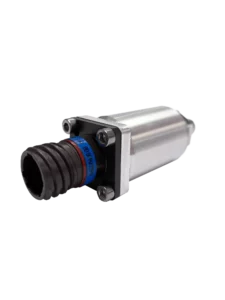
 HI6000 high-temperature pressure transmitter
 HI6000 high-temperature pressure transmitter
The HI6000 uses Silicon-on-Sapphire sensing technology in a compact pressure transmitter.
It is designed for continuous media and ambient temperatures up to 135°C. Limited operation is possible up to 150°C.
Pressure ranges are available up to 1,500 bar. A high-accuracy version is also available.
The HI6000 can therefore suit industrial and aerospace applications where both pressure and temperature matter.
HI2200 high-temperature pressure transducer
The HI2200 is designed for applications with temperatures up to 200°C.
It is available in pressure ranges from 1 bar to 1,500 bar. It also uses Silicon-on-Sapphire technology for accurate and stable pressure measurement.
Typical applications include aerospace testing, furnace monitoring and other high-temperature environments.
 HI5000 downhole pressure transmitter
 HI5000 downhole pressure transmitter
Downhole pressure measurement can combine several challenges.
Pressure can be extremely high. Temperatures can also rise significantly with depth. Equipment may then face vibration, mechanical shock and corrosive fluids.
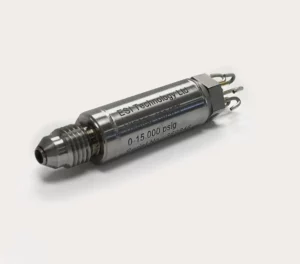
The HI5000 is designed for these demanding downhole conditions.
It can operate at temperatures up to 200°C, with pressure ranges up to 2,000 bar.
The compact transmitter uses Silicon-on-Sapphire technology. Its construction also provides stability in high shock and vibration environments.
Typical applications include logging while drilling (LWD), measurement while drilling (MWD), pressure while drilling (PWD) and well integrity monitoring.
Temperature and aerospace pressure measurement
Aerospace applications can expose pressure sensors to large temperature changes.
During testing, equipment may also experience vibration, pressure fluctuations and mechanical stress.
The pressure measurement equipment must therefore maintain reliable performance across the required temperature range.
Sensor stability is important here. So is accurate temperature compensation.
ESI’s pressure measurement solutions support a range of aerospace applications. ESI also holds AS9100D approval/certification for aerospace quality requirements.
Temperature and downhole pressure measurement
Temperature becomes particularly important when measuring pressure deep underground.
As depth increases, both pressure and temperature can rise.
Downhole equipment must continue to provide reliable measurements under these conditions.
The HI5000 was developed for high-pressure downhole applications. Its high-temperature rating makes it suitable for environments where pressure and temperature rise together.
This highlights an important point when selecting pressure measurement equipment:
Pressure range is only part of the specification.
Temperature, vibration, shock, media compatibility and installation conditions can all affect the choice of pressure transmitter.
Why is temperature range important?
When choosing a pressure transmitter, it is easy to focus on pressure range and accuracy.
Temperature is just as important.
Before selecting a transmitter, engineers should consider:
- What is the normal operating temperature?
- What is the maximum temperature?
- What is the minimum temperature?
- Is the temperature continuous or intermittent?
- What is the pressure media temperature?
- What ambient temperature will the transmitter experience?
- Could the temperature change quickly?
- Is additional cooling or remote mounting required?
- Is high accuracy needed across the full temperature range?
A transmitter that performs well at room temperature may not provide the same performance at a much higher temperature.
That is why the full operating environment should always form part of the specification.
Pressure and temperature work together
Pressure measurement does not happen in isolation.
Temperature can affect the sensor, the electronics and the materials around them. In turn, these effects can influence the pressure reading.
By considering pressure and temperature together, engineers can select a pressure measurement solution that provides reliable performance throughout the application.
From high-temperature industrial processes to aerospace testing and downhole measurement, ESI Technology offers pressure transducers and transmitters for a wide range of pressure and temperature requirements.
If you are unsure which pressure transmitter is suitable for your application, our engineering team can help you find the right solution. Contact us [email protected] or call +44 (0)1978262255. Find a distributor in your area here