Our Unit Converter
The ESI Unit converter allows you to quickly and easily access a conversion tool to work out your preferred unit of pressure measurement wherever you may be. Whether out on-site or in the office.

Download the ESI-USB© Software
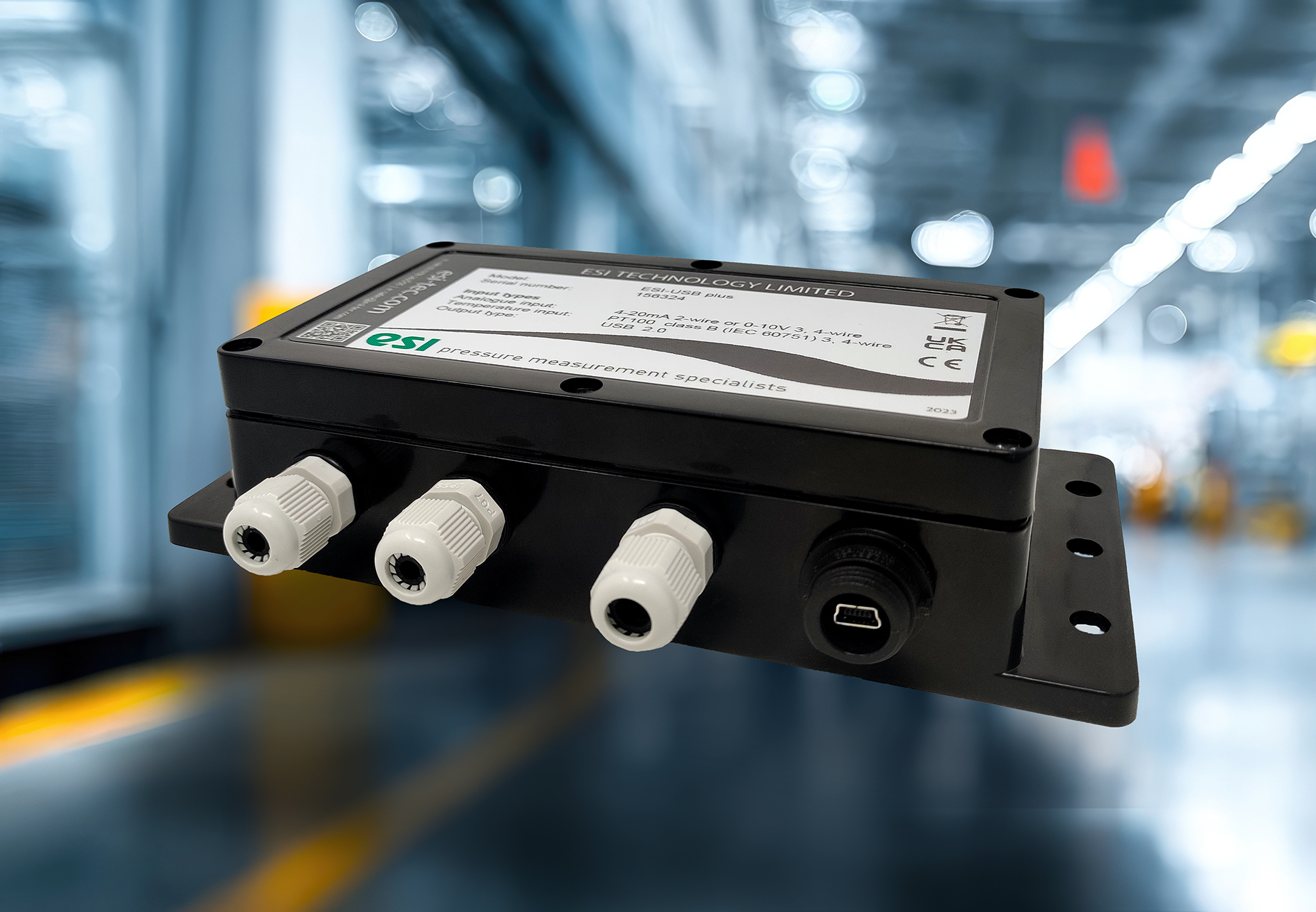
The ESI-USB© software allows you to connect your ESI transducer to your laptop or PC and be up and running monitoring pressure data within ten minutes. The software auto-updates and is compatible with Windows 8, 10 & 11.
Pressure measurement is one of those details that can make or break a system. Get the wrong sensor and you’ll see unstable readings, drift, failures in harsh media, or control loops that never quite settle.
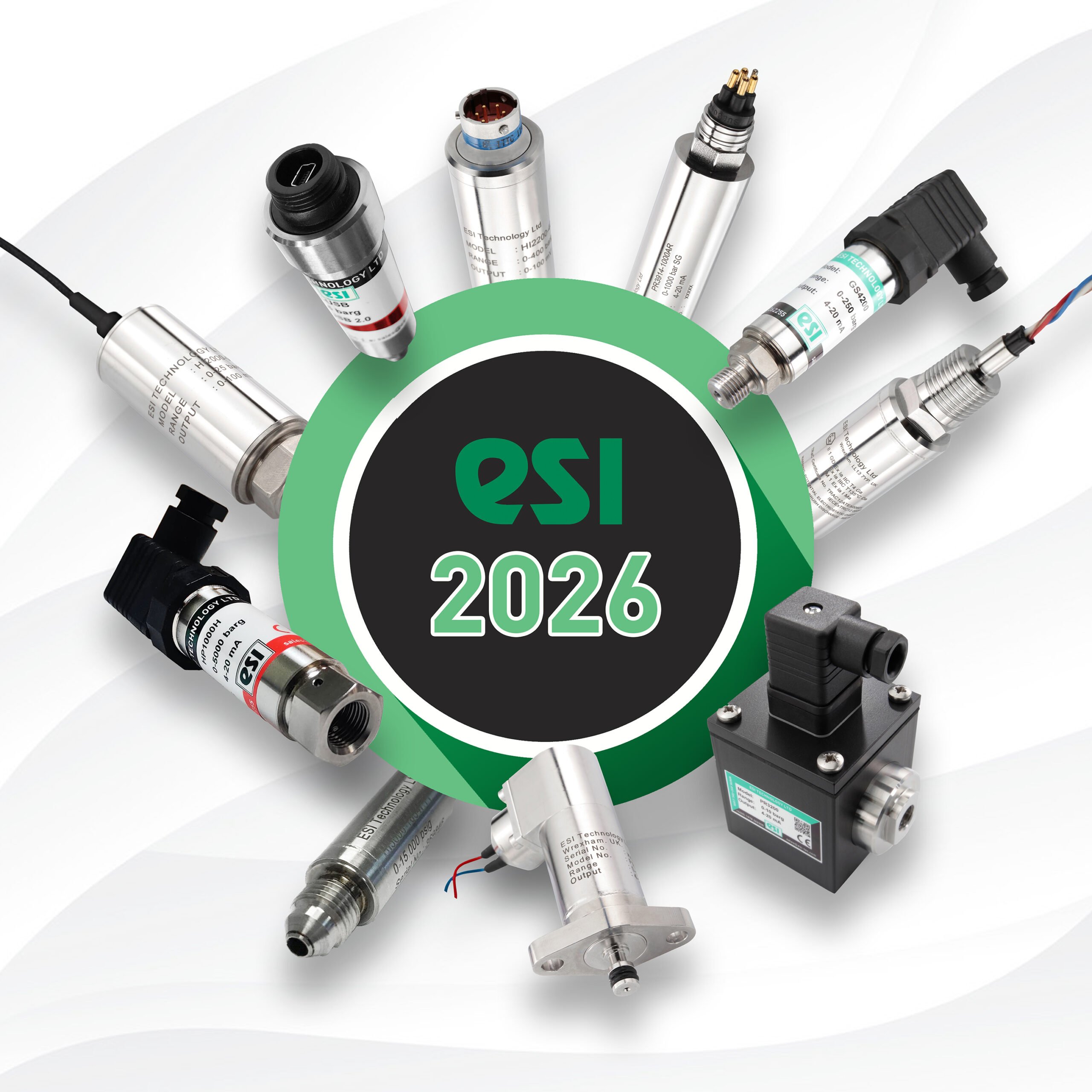
This guide explains pressure transducers in plain language: what they are, how they work, the main types (absolute, gauge, sealed gauge, differential), common output signals, and a practical checklist for selecting the right device for your application—based on how we approach pressure measurement at ESI
What is a pressure transducer?
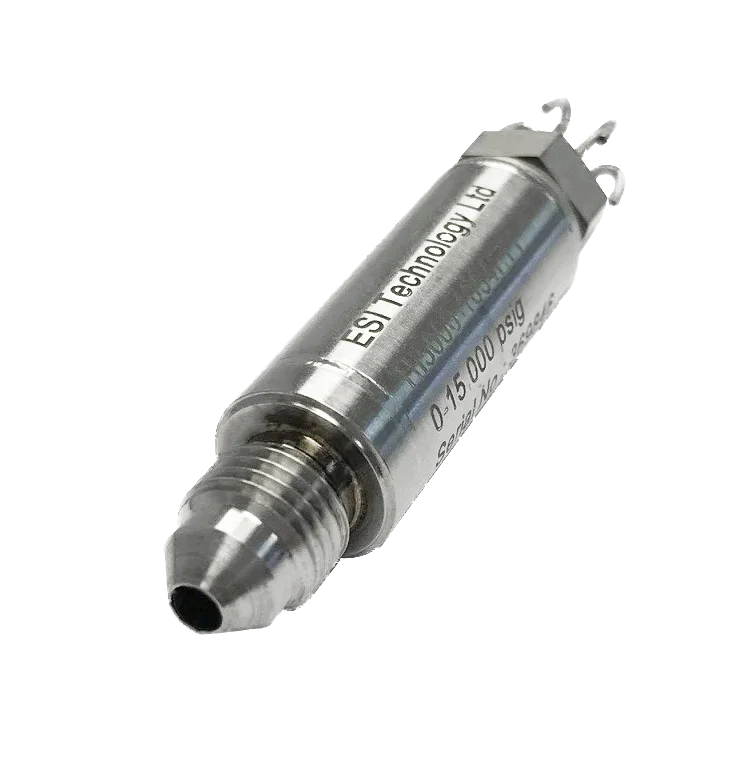
A pressure transducer converts pressure (force per unit area) into an electrical signal you can measure, record, or use for control.
In most industrial applications, the transducer is measuring pressure in:
-
liquids (hydraulics, water, fuel)
-
gases (air, nitrogen, refrigerants)
-
process media (chemicals, food-grade products, slurries)
How does a pressure transducer work?
At the heart of a pressure transducer is a sensing element that deflects slightly under pressure. That microscopic movement is converted into an electrical change, then scaled into a usable output.
ESI Technology uses Silicon-on-Sapphire (SoS) sensing technology across many high-performance ranges, designed for stability and demanding environments.
Pressure transducer vs pressure transmitter: what’s the difference?
People often use the words interchangeably, but there’s a practical distinction:
-
A pressure transducer can refer to the sensing device producing a signal (often voltage or mV/V).
-
A pressure transmitter typically includes additional conditioning electronics (linearisation, compensation, amplification) and commonly outputs 4–20 mA or another robust signal for industrial control systems.
If you’re running long cable lengths or noisy environments, 4–20 mA is often preferred.
The 4 main reference types (this is where many specs go wrong)
1) Gauge pressure
Measures pressure relative to ambient atmospheric pressure. Typical for hydraulics and pneumatics.
2) Absolute pressure
Measures relative to a sealed vacuum reference. Used for vacuum systems, altitude simulation, and processes where atmospheric changes matter.
3) Sealed gauge pressure
Gauge pressure, but referenced to a sealed “fixed” atmospheric value. Useful where you don’t want readings to move with weather changes.
4) Differential pressure (ΔP)
Measures the difference between two pressure points (P1 – P2). Common for filters, flow measurement across an orifice, and level measurement in tanks. ESI’s catalogue includes differential ranges from very low pressures up to high DP ranges depending on series.
Common output signals you’ll see
Your choice depends on the control system, wiring distance, and noise environment:
-
4–20 mA (industry standard for robustness and long runs)
-
0–10 V / 0–5 V (common in machinery and OEM systems)
-
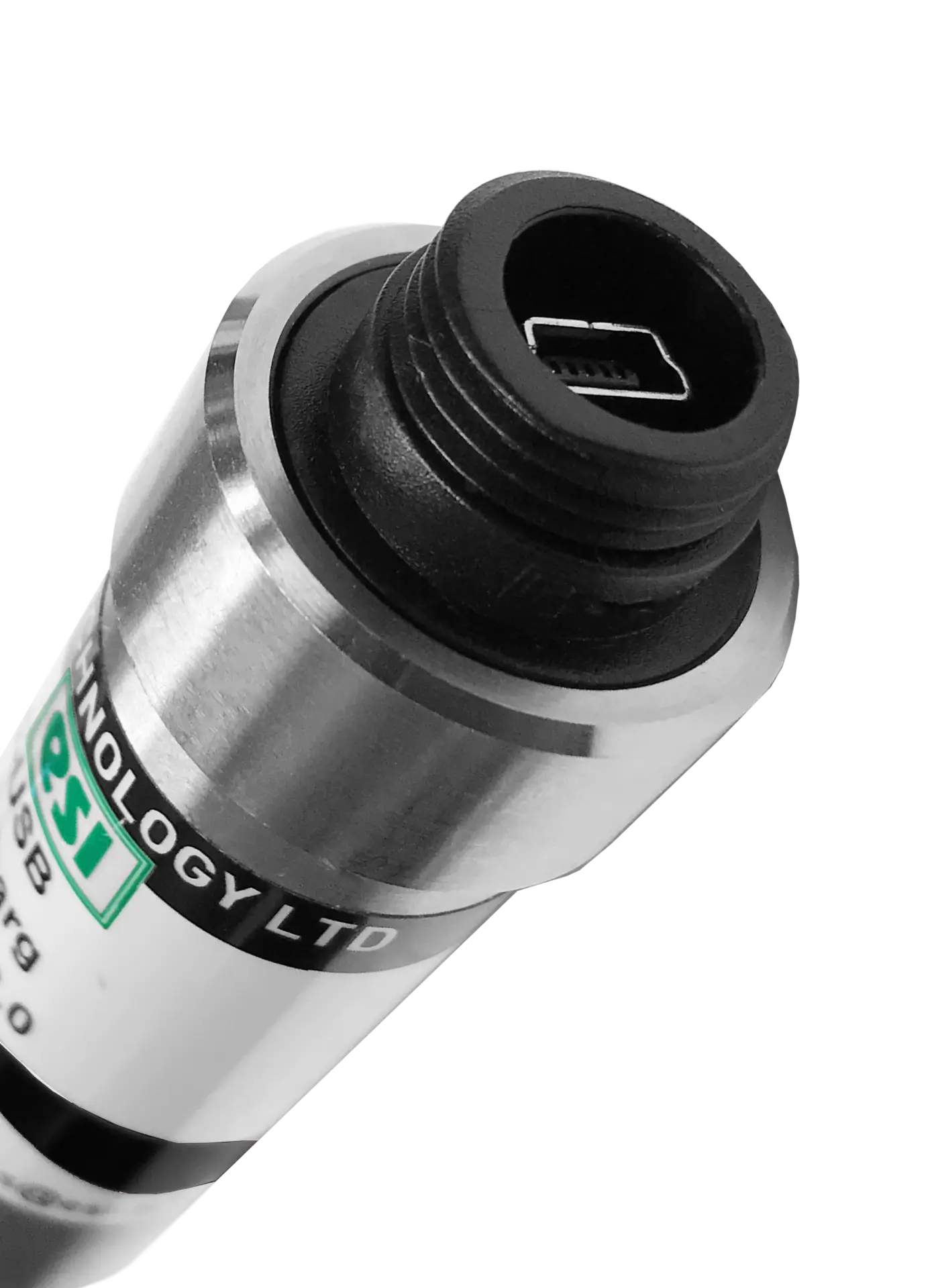
Digital outputs (useful for test, calibration, and data logging; some ranges support USB measurement and recording)
Accuracy, stability, and temperature effects (what matters in real life)
Datasheets can look similar until you focus on the details that drive performance:
-
Accuracy: how close the reading is to the true value across the range
-
Repeatability: how consistent readings are under the same conditions
-
Temperature compensation: how well the sensor holds accuracy across hot/cold operation
-
Long-term drift: how much the output changes over months/years
ESI highlights factors such as minimal temperature effects, drift resistance, and high-resolution output options as key performance goals for high-precision measurement.
Hazardous areas and explosive atmospheres (what you need to know)
In many industries, pressure transducers are installed where flammable gases, vapours, or dusts may be present. Oil and gas production, chemical processing, hydrogen systems, fuel handling, and marine applications are common examples. In these environments, the sensor itself must not become an ignition source.
That’s where hazardous area approvals come in.
ATEX and IECEx explained
Two of the most widely recognised certification schemes are:
ATEX
A European directive that governs equipment used in potentially explosive atmospheres. ATEX defines zones (for example Zone 0, 1, 2 for gases and vapours) based on how often an explosive atmosphere is present, and specifies the protection methods allowed in each zone.
IECEx
An international certification system aligned closely with ATEX requirements but accepted globally. IECEx simplifies compliance for equipment used in multiple regions and is often required for international oil and gas, marine, and industrial projects.
Many pressure transducers are certified to both ATEX and IECEx, ensuring suitability for use in hazardous areas worldwide when installed correctly.
Intrinsically safe vs explosion proof (a common point of confusion)
These terms are often mixed up, but they describe very different protection philosophies.
Intrinsically Safe (IS)
Intrinsic safety limits the electrical energy available in the circuit so that ignition is impossible, even under fault conditions.
Key characteristics:
-
Very low power and temperature rise
-
Safe by design rather than containment
-
Requires associated safety barriers or isolators
-
Typically used in Zone 0, Zone 1, and Zone 2
IS pressure transducers are common in instrumentation and control applications where signals must be brought back to control rooms safely.
Explosion Proof (Flameproof)
Explosion-proof protection assumes an internal ignition can occur. The enclosure is designed to contain the explosion and prevent flame propagation to the surrounding atmosphere.
Key characteristics:
-
Robust, heavy enclosures
-
No need for intrinsic safety barriers
-
Typically larger and heavier than IS devices
-
Common in North American installations and certain Zone 1/Zone 2 applications
Choosing the right protection method
The correct choice depends on:
-
Hazardous area classification (zone and gas group)
-
Power and signal requirements
-
Installation practices and available infrastructure
-
Weight, size, and maintenance constraints
For many modern process and monitoring applications, intrinsically safe pressure transducers offer flexibility, lighter installation, and easier integration with control systems. Explosion-proof designs may still be preferred where high power is unavoidable or where legacy standards apply.
ESI Technology offers pressure transducers and transmitters with ATEX and IECEx approvals across selected ranges, supporting intrinsically safe designs for hazardous environments without compromising accuracy, stability, or long-term reliability.
Where are pressure transducers used?
Pressure transducers show up almost everywhere, but these are especially common:
-
Hydraulics and mobile equipment (load sensing, pump control, diagnostics)
-
Oil, gas, and subsea (corrosion resistance, high static pressure, long service life requirements)
-
Aerospace and test & calibration (accuracy, traceability, stable repeatability)
-
Process industries (chemical compatibility, cleaning, CIP/SIP considerations)
-
Hygienic applications (flush diaphragms and sanitary fittings where cleanability matters)
How to choose the right pressure transducer (quick checklist)
If you’re specifying a transducer, gather these details first:
-
Pressure range
Choose a range that covers normal operation and expected spikes. ESI’s catalogue includes options from vacuum up to 5,000 bar depending on product family. -
Reference type (gauge / absolute / sealed gauge / differential)
This is the #1 cause of “the readings don’t make sense” commissioning issues. -
Media compatibility
What touches the wetted parts? Consider corrosion, abrasion, and clogging risk. Flush diaphragm designs can help where ports block or need cleaning. -
Temperature (media + ambient)
High temperature needs proper sensor technology, packaging, and compensation. ESI lists high-temperature designs operating at pressure ranges up to 1,500 bar for certain series. -
Output signal + electrical connection
Match your PLC/DAQ requirements and cable lengths (4–20 mA is often safest industrially). -
Approvals and hazardous areas
If you’re in potentially explosive atmospheres, look for the right approvals (for example ATEX/IECEx on applicable ranges). -
Calibration and traceability
If you’re in regulated or high-accuracy environments, ensure calibration is traceable and documentation meets your QA needs.
Installation tips that prevent 80% of field issues
-
Avoid mounting where vibration is extreme unless the device is specified for it
-
Use proper sealing (thread seal, torque, washers) to avoid micro-leaks
-
Minimise trapped air in liquid lines (or you’ll see noisy, slow response)
-
Protect against pressure spikes (snubbers, dampers, accumulators if needed)
-
Route cables away from VFDs and high-noise sources, especially for low-level signals
FAQ
What does a pressure transducer measure?
It measures pressure and converts it into an electrical signal (like 4–20 mA or 0–10 V) for monitoring or control.
Which is better: 4–20 mA or 0–10 V?
For industrial environments and longer cable runs, 4–20 mA is usually more noise-resistant. Voltage outputs can be fine for short runs in low-noise machinery panels.
What’s the difference between gauge and absolute pressure?
Gauge is relative to atmospheric pressure; absolute is relative to a sealed vacuum reference.
Can pressure transducers measure vacuum?
Yes—there are ranges designed for vacuum through to high pressure; ESI lists selections from vacuum up to 5,000 bar (by series).